Death Penalty on the Radio

So, I recently went of the radio with my fellow co-leads of my pro-bono group to discuss the death penalty, a rather controversial topic to be listening to while you drive home from a busy day at work but nonetheless, that’s what we did. This was not something I was looking forward to, I’m not someone that strives for the limelight, I’d rather work hard, get on with what must be done and then take satisfaction in having been self-motivated but regardless, I was asked to do so and it could only benefit the process of raising awareness.

While many others I knew who also were requested to talk on the radio about legal matters had prepared a script, I decided that this was better prepared for by merely double checking facts I wanted to highlight and then having a natural response to the questions asked of me. I hoped this would make for a less rigid conversation and give off a more natural dialogue, and according to some friends that were listening, I was right! Phew, I’m glad I didn’t sound too much like an unprepared fool!

One of my fellow co-leads actually had a very personal connection to this cause, having been born and raised in Belarus, who still actively have the death penalty, and so at the very least I think that having him speak is rather interesting, listening to how worrying it is to be in a country where you can legally have you life taken away.

The process was rather simple, we were asked questions randomly and we just had to answer as well as we could with hopes that we shall at least spark some interest, as well as a little self-promotion of future events we plan to host. We ended up speaking for much longer than we expected to! 30 whole minutes!

The concept of the death penalty is one that many Britons don’t care about, we don’t have it so who cares? Well… I do. Yes, we are not residing in a country that still executes people however we can still be subjected to this, a perfect example being Lindsay Sandiford, an extremely interesting situation I highly encourage you all to investigate. Additionally, just because it isn’t us doesn’t mean it isn’t someone, that is someone’s child, parent, lover, etc. they may have committed a crime but is such suffering from everyone that knew and cared for that individual necessary? I personally don’t think so.

Regardless, I am under no delusion that there is opposition to my stance and that’s fine. Independent thinking is a good thing! But when an opportunity gets handed to you to do something to try and help a cause you strongly believe in, as much as I didn’t want to speak on such a public scale, you must grab it.

And so goes my rather unexpected adventure into public radio!

Photo by Filip Barna on Unsplash
Trial by Jury; in need of abolishment?

Juries are often considered necessary due to ‘tradition’, a fundamental key to democracy and allows people to be judged by their peers, but does that mean that juries are ‘better’ or needed?

Should the way you receive legal judgement be a weighing of odds? Juries are made up on 12 members, you only need two of them to think otherwise in order to bring around a hung jury.

Juries ARE traditional within the UK legal system, able to be traced all the way back to Magna Carta. They are selected at random, typically having only minimal legal knowledge, and so this can bring about a lot of debate; should those without legal knowledge give a legal judgement? Are their decisions based on law or based on their moral beliefs? Due to the privacy extended to juries we can’t see their deliberations, and so we may never know how they come to their conclusions or their reasoning; the jury verdict is sacrosanct.

But why do we view juries to be so important?

  • Acting as a system of checks and balances,
  • Prevention of tyranny,
  • Represent the voice of the people,
  • Allows for an ‘open’ system of justice,
  • Operates as a balance against state interference,
  • Supposed ‘impartiality’

But are these all valid advantages?

The purpose of a jury is to act as a representation of the public; however, this is not likely. First, the manner in randomly selecting jury members does not always equate to a wide selection of individuals offering difference backgrounds, an example of this is the American case of Rodney Reed, an African American man that had an all-white jury. It can be argued that just because of racial differences doesn’t mean that will impact the decision, however racial biases have been well documented within the legal system, with the NAACP stating that African Americans are incarcerated 5 times more than the rate of white individuals. Nobody is immune to the effects of biases, we all have thoughts and opinions, experiences and beliefs that colour our opinions within life.

Often juries have been referred to as ‘the victims of skilful lawyers’, manipulation is a skill that is often used when formulating an argument, and so it is only logical that lawyers tend to develop a rather talented way in offering an argument to the jury to elicit the reaction they desire. Sometimes things that can be considered irrelevant to the facts of a case can have an impact on how the jury comes to a conclusion, such as the personality demonstrated by the prosecution and defence, if they appear more likeable are a jury going to sway in their favour? If a judgement was made by a judge, they have a duty to focus solely on the facts and legal reasoning, but with no minimum level of education required of a jury, are they always able to pick out legal reasoning and relevant information?

Additional disadvantages are;

  • Media influence,
  • Jury vetting is against principle of random selection,
  • Potential boredom,
  • Difficulty to follow complicated cases,

Judges, while having a legal background and the ability to pick out legal reasoning, are not infallible, I shall briefly highlight these.

  • We all fall prey to biases.
  • Concern that judges can be TOO removed from the situation, sometimes crimes can occur out of the circumstances surrounding the individual, such as desperation.
  • A judge being the sole deciding factor within a case, does not allow for the differing of opinions and perspectives.
  • Are we giving judges too much power?

What is your opinion on jury trials?

Photo by Bill Oxford on Unsplash

Making your non-legal experience work for you

You’ll notice in the many, many, many applications you fill in throughout your time studying law that almost all are interested in your work experience and history, both legal and non-legal. Now, instead of listing a skeletal work history with your duties and responsibilities, whether relevant or not, you really need to tailor your answer to display transferable skills you can bring to the role you’re applying for from the experience that you have.

For example – I work as a team leader part time, what I would be looking to highlight within my explanation of the role would be: leadership, communication, interpersonal skills, teamwork, adaptable, calm under pressure…

In essence there are many different skills that make a good solicitor/barrister, and you just need to find examples of your responsibilities, or experience at work to demonstrate that you have what they are looking for.

Many of us that work part time alongside uni, or over the holidays in a customer service environment, which almost immediately shows transferable skills: communication, interpersonal skills, and maybe even teamwork.

Whereas in technical/administrative roles the skills may be organisation, time management, communication, eye for detail, self-motivated (particularly important in barristers as you will be self employed and need to have the determination to succeed).

No work experience?

Even if you don’t have work experience to show skills, you can demonstrate these skills through your studies and events that you have attended.

University experience
Even if you haven’t had to work alongside your studies, you can use university to demonstrate some of these: time management, analytical, teamwork, leadership, communication, interpersonal skills. It is simply a matter of finding examples – use groupwork assessments to show teamwork, and if you in any way took a leading role within the team, use it to show leadership. Communication can be shown through presentations, and again group work could also act as an example.


Networking events have the potential to be an excellent example of interpersonal skills; by building a rapport with various individuals, listening to them and learning about them. You want to show active listening, empathy and an ability to connect with people.


Volunteering
Doesn’t matter what field you volunteer in, you’re almost guaranteed to find useful skills – and if you have taken on a more administrative role within an organisation then this could be experience that has developed your eye for detail/analytical skills, time management, organisation…

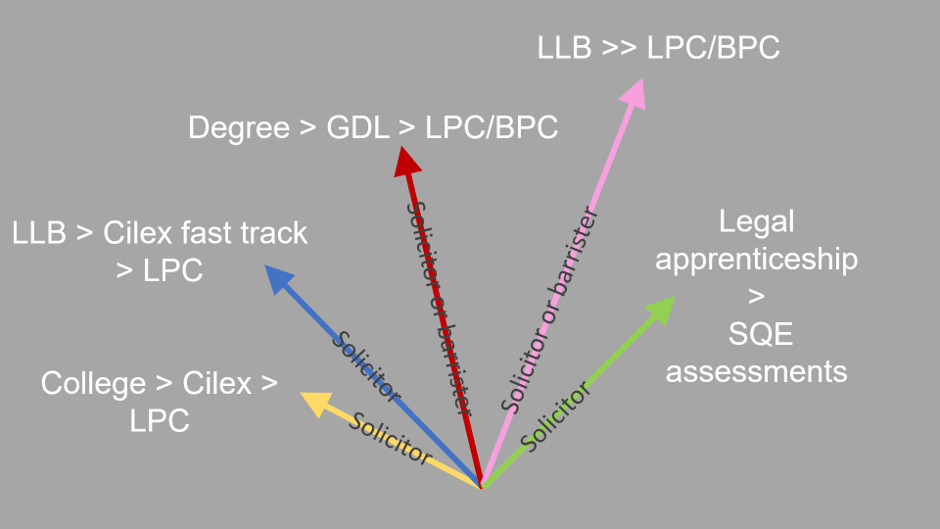
The different routes into law

Now, the routes will always be subject to changes here and there, and as I write this now there is a huge shake up being planned for the route into becoming a solicitor, however I will cover what I can with what I currently know.

The route for a barrister and solicitor is comparable, but still very different.

Solicitor

The traditional route for a solicitor is:

  • A qualifying Law Degree – when you choose your Y2 and Y3 module options there will be 2 in each that are necessary for a qualifying degree, if you don’t choose them you won’t be able to go onto the LPC after graduation.
  • After you’ve completed your degree you will have to complete the Legal practice course, which if taken full time lasts one year (2 years for part time), this is where you learn the more practical and vocational skills, rather than theory.  
  • On completion of the LPC you will need to secure yourself a training contract. For most firms, training contracts are recruited for 2 years in advance, which means when you are in your second year you should be applying for training contracts. This is not to say that you won’t get one if you wait longer, you can apply for them at any time (once application windows open of course) but it just means you may have a year or two after your LPC until your training contract actually starts.
  • ^^ If you’re in this boat, my advice to you is to try and gain as much legal experience as possible in the meantime, such as working for a firm as a paralegal.

The SQE (Solicitors Qualifying Exam)

The new approach to qualifying as a solicitor is being finalised at the moment, preparing for roll out in 2021, however considering how many times it has already been postponed, there is a good chance it will be further delayed. This new route has come about to make the path towards qualifying as a solicitor fairer and to standardise the content that is delivered to aspiring solicitors. The SQE consists of two assessments, the last of which is very practical, and so is likely to be difficult if you haven’t gained a great deal of experience.
The positive about this route is that training contracts are no longer required, instead you need to simply gain two years of experience working in a law firm in a capacity such as a paralegal or trainee role. It is also rumoured to be much cheaper than the current LPC’s that are on offer, which makes the route to becoming a solicitor also much more accessible.

Legal Apprenticeships

Solicitor apprenticeships are offered through law firms. Instead of going to university you earn a degree whilst working full time at the firm. This route to qualification lasts between 5 and 6 years and is taught entirely via online modules at the cost of the employer and the government. To qualify as a solicitor, you will need to pass the new SQE assessments instead of going onto an LPC.

Cilex

Both graduates and non-graduates can take this route, however the content and actually course taken will be different; graduates can take a fast track course to become a chartered legal executive, which is as you’d imagine, much quicker.
Now, becoming a chartered legal executive still requires you to complete an LPC to become a qualified solicitor, however, it exempts you from needing to fulfil a training contract to become a practicing solicitor. This is a huge bonus in a climate where training contracts are quite hard to get, but it does come at a small cost which you won’t get a loan for. Cilex are also teamed up with De Montfort university, and from what I gather, the LPC’s can be discounted in recognition of the graduate fast track qualification – but not for those who haven’t gotten a degree first.

Barrister

The traditional route to becoming a barrister:

  • As I’ve said, this is pretty similar in terms of stepping-stones to becoming a solicitor. The first step is to complete a qualifying law degree at university (open uni or an institution but open uni is considerably longer).
  • From this you will need to apply and complete the BPC (Bar practice course), which is the practical skills and knowledge of being a barrister.
  • After your BPC you will have 5 years to attain a pupillage at a Chambers – this is no small feat, the pupillages are highly competitive, and the applications are an intensive and gruelling exercise. You are able to apply for pupillages a year in advance, however in my experience many BPC students don’t secure a pupillage until after the BPC, and it can take up to 5 years. If it takes longer unfortunately the BPC qualification will no longer be valid…

For the graduates without a law degree looking to become either:

The GDL

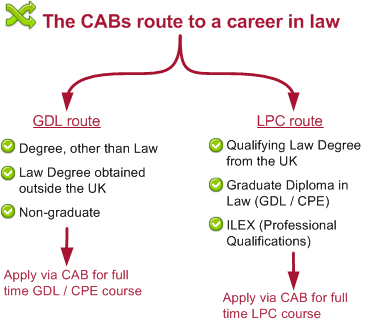
  • If you’ve achieved a degree that isn’t in Law then you can still go on to the LPC or the BPC if you take a one-year course called the GDL (Graduate Diploma in Law), also known as the law conversion course. It’s more or less a crash course into the law to prepare you for the next stage of training.
  • If you want to become a barrister, you will want to apply for the BPC after your GDL finished, whereas if you want to become a solicitor then you will want to apply for the LPC instead.
  • On completion of those courses, barristers will need to find themselves a pupillage, and solicitors will need to secure a training contract. Again, you are able to apply for these two years in advance as well regardless of your degree discipline.
  • ^^ This is actually a great route, and not a disadvantage at all, law firms are often looking for well-rounded candidates, and with life sciences and technology on the rise graduates from those disciplines are well sought after.  

In summary, there are plenty of different options and paths to consider when becoming a solicitor, not so much for a barrister, and the best advice is really to research them all and choose the one that suits you best – even if it isn’t the path most followed.

Applying for the LPC

So, being a solicitor is the path for you, huh? You’ve prepared yourself mentally for the pain of vacation schemes, the legal practice course and training contracts? Damn you’re brave. Honestly the idea of getting a training contract these days seems like a fantasy. You’ve achieved your GDL or QLD and a 2.2 (but make sure to check your preferred uni’s requirements!).

One of the first things to know is that the LPC is expensive BUT taking a masters alongside the LPC, while being a painful concept, will help cover the costs, not entirely but hey, beggars can’t be choosers. Another way to minimise the expense is to consider the discount often provided if you do your postgraduate course at the same university that you carried out your undergraduate, this is sadly not possible for all universities. Other than that, my only other advice is prepare yourself for getting a job to fund it. Oh, and kiss your social life goodbye!

The LPC application is rather straightforward, you use LawCabs to choose up to 4 institutions you want to study at and follow along with their instructions. Easy! Except no, because now you must beg a teacher that knows you and likes you to write you a reference, and a glowing reference is even better so making sure to be on your best behaviour (i.e. turn up to class!).

Next, do you remember the pain of writing a personal statement for your undergrad? I certainly do, I wasn’t sure what degree I wanted to take so mine actually had to be so general it could be used for four different topics! I do not advise. Now if you’re applying for the LPC, there’s clearly only one topic you need to demonstrate a love of, the wonderful world of law! Talk yourself up, discuss why you love law, why you need to be a solicitor and how you deserve to continue your legal studies. My best piece of advice is to google an example personal statement, and don’t get too overwhelmed by what they have done, we aren’t all robots with impeccable work ethic, sometimes things get in the way of achieving all these accomplishments. Then you spend £20 submitting it and pray someone takes mercy on you.

Rape Myths

Some of the deep rooted beliefs that s.41 YJCE Act 1999 aims to extinguish

Those pesky archaic beliefs held about rape that have no real bearing on actual rape, defined by Burt, 1980, p.217 as being “prejudicial, stereotyped, or false beliefs about rape, rape victims and rapists”. These ill-conceived beliefs can even impact the way police officers view this type of crime. While admittedly we all fall foul to some misguided ideas, by police falling prey to these myths, it can result in a lack of recording of reports, victims fearing the actual process of reporting and even an unprofessional manner of investigation.

These myths have a very long history within our society, with many believing that a ‘true’ rape is a violent rape by a complete stranger, that the complaints of rape are primarily false and that if the survivor of rape doesn’t report the event immediately, that they have fabricated it. This is an extremely traumatic experience, immediately reporting it is something very rare, it can take time to talk about, especially when reporting will result in being pressed for in depth detail.

The Office of National Statistics, in 2013, stated that only 14% of rapes offences get reported. Rainn.org has stated that only 11% of rapes and sexual assaults involve the use of a weapon, including personal weapons, such as hands, feet or teeth. In fact, a study conducted by David Lisak et al. concludes that only 2-10% of reports are false, this is an incredibly low percentage. However, with Rainn.org stating only 5 out of 1000 rapists get incarcerated, the Washington Post puts this slightly higher at 7 out of 1000, regardless, it is always below 1%, so is there any wonder male and female survivors don’t always report?

Some of the common myths about rape are as follows:

  • Sex with some incapacitated by alcohol or drugs isn’t rape,
  • You can’t rape your partner/spouse,
  • Rape requires physical restraint,
  • Only young ‘attractive’ women and girls, who flirt and wear ‘revealing’ clothing get raped,
  • Men don’t get assaulted,
  • Women don’t commit sexual offences,
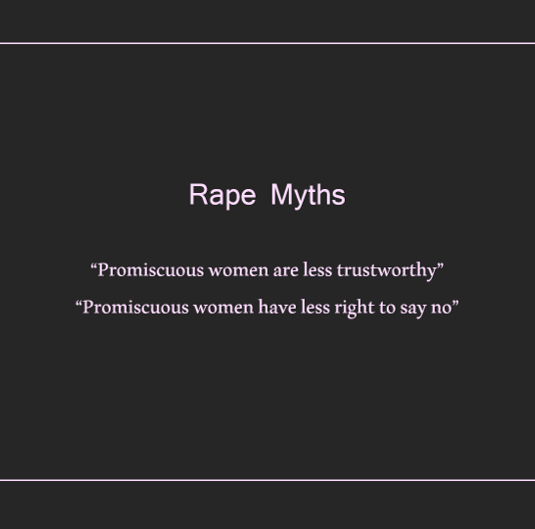
  • Women who ‘sleep around’ can’t be raped,
  • Etc.

R v A (No. 2) [2001] Lord Stein – “the discredited twin myths…that unchaste women were more likely to consent to intercourse and in any event, were less worthy of belief… Such generalised, stereotyped and unfounded prejudices ought to have no place in our legal system. But even in the very recent past such defensive strategies were habitually employed. It resulted in an absurdly low conviction rate in rape cases. It also inflicted unacceptable humiliation on complainants in rape cases.”

Rape myths are so integrated within our society that they can even play a role within the judiciary, and within the adversarial system between two barristers. Using these myths have been found within two studies – Adler 1987 and Lees 1996 – as a common tactic for defence barristers. Thankfully legislative changes were introduced, such as s.41 Youth Justice and Criminal Evidence Act 1999, which restricts the evidence and questions able to be asked regarding a complainant’s sexual history, however it does provide four circumstances for when it can be used.

Past sexual history as evidence in rape cases shall get its own personal discussion in subsequent posts – there’s a lot to be discussed, R v Evans and the ‘floodgates’ argument for example!

Just because a survivor of this terrible ordeal does not fall into this preconceived ‘perfect victim’ stereotype does not mean it did not happen. It does not mean it was their fault, and they shouldn’t fear the repercussions of coming forward.

For Support –

SARCC – https://www.nhs.uk/service-search/other-services/Rape%20and%20sexual%20assault%20referral%20centres/LocationSearch/364

https://www.nhs.uk/live-well/sexual-health/help-after-rape-and-sexual-assault/

NSPCC helpline: 0808 800 5000

Applying for the BPC

So, you’ve decided you want to become a barrister? You’ve considered all of the cons of this path: the competitive nature of pupillages, the difficulties of securing a tenancy afterwards, the uncertainty of income when you’re self-employed, and the costs of the BPC… well done, you must be dedicated.

First thing that is worth knowing is that the four Inns of court offer scholarships to students to help with the costs of the BPC and the deadline for these applications is before you even apply for the course. Each Inn has a different amount of funding available, and some are more competitive than others, so you’ll want to research the Inns a little and find which one will be the most suitable to you.
For example, I wanted to apply for Grays Inn, they shortlist interviewees from the applications, and scholarships are based on merit alone, however I unfortunately missed the deadline and instead ended up applying to Inner Temple (a happy accident, they interview all applicants, and whilst based on merit, they also consider financial need).

The scholarship application

The applications aren’t too daunting, the Inn is looking for information about you and why you should get the funding, if you’re applying to Grays Inn and Lincolns Inn then the application is very important, if you don’t stand out and have strong academics, you most likely won’t get an interview. However, the Temple Inns will interview everyone, which is a serious pressure reliever, but doesn’t mean you can just breeze through – you still want to be a strong candidate.
You will need two references, academic or professional, and they will have to complete their forms on a deadline as well – I had to chase both of mine to get them to do it on time! The best choice would be your lecturers, and make sure to choose the ones who have already marked some of your work so they can really speak to your academic ability.
If I remember right, the deadline for all of the applications is the 13th of December, so get that in your diaries!

Preparing for the scholarship interview

There is a plethora of information regarding scholarship interviews, how to best prepare and what to expect. Whilst I have not gone through the process yet, I have my interview scheduled a month from now, and have already started preparing (YouTube has some great stuff!).

I have learned that one of the interviewers will attempt to spark a debate with you, either disagreeing with something you’ve said, or taking something from your application and ask you to persuade someone to your point of view. Do not bow down to them and sway to their viewpoint, they want you to stand up for yourself and create a coherent argument under pressure – it’s a key attribute for a barrister, and they want to invest in someone who will succeed.
There is also a small task included with the interview, on the day you will be provided with a case, for which you must come up with an opinion. Something I’ve never done and haven’t started preparation for, but I will be soon. Of-course there will be no right or wrong answer, it’s all about your reasoning and understanding on the law.

The interviews are only short, 15 minutes long – but I have no doubt that they will be tough, and highly competitive – especially with the bigger inns such as inner temple and middle temple, as they may have the most funding, but they also have the most applicants, and hold interviews with every single one

For this reason, I would advise anyone applying for scholarships to really get to grips with key questions: why you want to practice law, why you chose to be a barrister, why not a solicitor? Also get to know your CV and application answers so you can prepare yourself for questions about yourself and what you’ve told them.

The BPC application

  • ULaw: requires a minimum 2.1 for the BPC, and a pass on the BCAT
  • UWE: requires a minimum 2.2 for the BPC and a pass on the BCAT

This application is a bit longer than the scholarship one; in fact, I’ve only just finished mine!

For the BPC you apply directly to the institutions, unlike the LPC where you apply through Law CAB. I personally have applied to ULaw, and the application is very standard; your personal details, academic qualifications, references and personal statement, along with a statement of when you’ve displayed excellent communication.
They again give you a lot of guidance on what you should include in your application, and also what you shouldn’t include – such as, how law was your childhood dream.

I have also started my application for the BPC at UWE, as an alum I get a 15% discount, which is very helpful when the course is so expensive! So far, the application appears very easy, and less information is required than ULaw.

  • The BPC interview

The next step for ULaw should I pass their initial paper sift will be an interview with one of the lecturers which should last about 10 minutes, and a 5-minute plea in mitigation.
For this the best preparation will be similar to the scholarship one: knowing why you want to be a barrister, why the law, why ULaw etc.
For the plea, I am going to talk to one of my lecturers who is a barrister and hopefully he will be able to give me some guidance on it – don’t be afraid to make use of your lecturers for these sorts of things, if they don’t have the expertise they can direct you to another member of staff who does!

So far, UWE has not mentioned an interview or any kind of assessment and so I imagine that should the application be accepted then you may secure a place on the course, subject to your results – however once I’ve submitted and hear back from them I will update you guys!  

  • Key tips:
  • Be confident – this can be hard, especially when your being judged by a panel of people but remember that they want to give you the scholarship/course place, and they just need a reason to.
  • Be yourself – this goes hand in hand with confidence to me, let your personality shine through in your conversation and answers.  
  • Be prepared – a fundamental requirement, the last thing we want is ‘ums and ah’s’ as our answers!

I hope this has been helpful for you, and I wish you all the best of luck!

Critical Analysis

Critical analysis is one of those really annoying parts of an essay, however it is needed and it is where most of your marks come from, especially as you go up years in uni. So we’re going to help you, and ourselves, get better!

CA is the ability to work out within a problem or question, what is and isn’t important information, e.g. the fact that this couple often argued isn’t relevant in a case of constructive trusts.

  • You must apply the knowledge you’ve learnt from your lectures and outside reading to the problem/question.
  • Explain information in a concise and clear manner without repetition (this negatively impacts the word count!)
  • Work out what the best solution to the given problem/question is, or the best argument that can be made
  • Explain clearly why you have selected this solution/argument. Even if it’s not actually the best solution/argument, explaining how you came to this conclusion can actually gain you marks!

Descriptive VS Critical

Descriptive;

  • States what happened,
  • Explains how something works,
  • Explains what a theory says,
  • States the order in which things happened,
  • Gives the story so far,
  • States what something is like

Critical;

  • Shows why something is relevant or suitable,
  • Indicates why something will work the best,
  • Weighs one piece of information against the another,
  • Evaluates, and judges the value of, strengths and weakness,
  • Makes reasoned judgements,
  • Identified the significance

To be critical you need to back up your opinions with evidence, show that you can do more than state arguments but actually asses the merits of a given argument, weigh pros and con against each other. This will show that you have a wider understanding of your topic, rather than just the ability to repeat information. Of course this means a lot more wider reading around the topic – wonderful! More reading!

The typical characteristics of critical writing include;

  • Content – reasoning, relevant evidence, compare and assess alternative arguments, formulate your own opinion regarding the evidence.
  • Audience – consider how what you write will influence those reading it, will it be persuasive?
  • Clarity – your writing must be clear, concise and easily understandable. You wont gain marks if your marker cant flow your train of thought.
  • Analysis – look at the evidence in both an in depth detailed and critical manner.
  • Select evidence – look at your points, what evidence do you have to back it up? Is this a key point or does it seem like too much unnecessary information, potentially subtracting from the main argument?
  • Sequence – begin with good planning so that the most important points stand out clearly and make sure they connect to each other, e.g. a clear flow between the points.

Read → Interpret and Understand → Apply → Analyse → Evaluate → Conclude

Exam revision tips

Here’s the time for ‘do what I say, not what I do’. I’m talking from experience when I say that last minute cram sessions are not as effective as scheduled study sessions in the weeks leading up to the exams.

If I’m honest, I’ve found this advice very hard to follow, in fact, in my last exam just a few weeks ago I studied for 3 days with my friend before the exam, and when I say ‘studied’, I mean I learnt the information and then revised it. We actually did pretty well but consider how much better we could have done had we prepared more. That can be the difference between a 2.1 and a 1st.

Now, it has to be said that everyone is different, and what is effective for some people doesn’t work for others, and so if you know what suits you, then keep it up and try your best. If you’re still looking for the best way to revise, then have a read on some of my necessities when it comes to exam prep.

Necessity 1: Flash cards

This is arguably the most useful tool for me in revision, it prompts you to recall information that you’ve learnt, which is exactly what you’ll be doing in exam conditions.

Tip 1: The most effective way to write flash cards is in the form of a question, statements don’t have the same impact in my experience.

Tip 2: Something else I’ve read (but question its truth about) is that yellow is the best colour to choose for memory – so I’d advise you pick up a pack of coloured flash cards instead of the plain white ones.

Tip 3: Don’t write out lengthy answers, try to keep them short and sweet, bullet point if you have to – this is especially important when someone is testing you who has no idea about law, because they will literally expect you to answer them with the entire paragraph and won’t really know if you’ve got it right if you don’t. I learnt this the hard way.

Necessity 2: Mind maps

I LOVE mind maps. There was a presentation in school about the best ways to revise for the brain, and they showed us a particular way to create mind maps for the most effective revision. I’ve used this method ever since, and absolutely swear by it.

Tip 1: If you can, break an entire topic down into one mind map, and segregate the different aspects within it. You don’t want to have to look at multiple mind maps for one particular topic, you want it to be all tidy and in one place.

Tip 2: Use capital letters. According to a professional (don’t quite remember what he was qualified in) our brain processes capital letters easier than lower case ones.

Tip 3: Use different colours, I usually use a different colour on every line from the bubble I draw, however sometimes it is easier to have the different sections coloured accordingly.

I’ve uploaded a photo of one of my mind maps for you to get an idea of how I do mine, but of course it is up to you how you go about yours.

Necessity 3: Consolidation notes

Now this is something ideally, you’d do every week after your lectures, just consolidate all the necessary information into one document of notes, which you can then use for your revision to create mind maps and flash cards. Sometimes life does get too busy though, and so if you can’t do it every week that’s okay, just do what you can when you can.

Necessity 4: Study buddies

This is so incredibly helpful. Not only do you have someone to help you learn, test you and push you to keep going, you also have someone to panic and worry with. When I revise with Emma, we go through a topic, and usually after each page, or subject, we stop and talk about the things we have learnt, we write it down and test each other with our notes.
Once we’ve gone through an entire topic, we would create flash cards and mind maps, which we would use to test each other on at the end. Before this I would have revised primarily alone and then just used flash cards with friends before the exam, but now I’ve tried it this way, I wouldn’t go back to revising entirely solo.

The last tip I will give you in this post is to revise to schedule, because if you choose to revise only when you have the motivation to do so, you will barely revise. I hate to say it, but it’s true. Motivation is fleeting and unreliable, and you can go weeks without any at all, which is why you should create a realistic schedule of when you want to revise and try to stick to it. When I do this, I work in intervals, usually 20 minutes of revision and then a break, however this can be dangerous as the break will easily last longer if I open social media, or Netflix. Rewarding yourself for studying can be effective – a biscuit or ice-cream… this isn’t something that I do but have heard it works.

I bought a Clever Fox planner to schedule my time with, and what is really great about it is that you write in your goals, ranging from 3 months to 30 years, and it has a section for what you will reward yourself with if you achieve the goal. This could be used, if you set a goal to reach a certain grade, or revise a certain amount, then you’ll buy yourself whatever you’ve chosen. I’m pretty sure I set a target for what grade I wanted, and my reward (if achieved) will be a new laptop!

The Death Penalty – Methods Used

Within the UK we no longer have the death penalty, with the last execution happening in 1964, and true abolishment occurring five years later. So, why should we care? It’s happening in many countries across the world, but it’s not happening here, so… out of sight out of mind huh?

This is the wrong kind of thought to have on the matter, it’s not happening here but it is happening to our global neighbours. Most executions recently occurring take place within China, Iran, Saudi Arabia, Viet Nam and Iraq, and while China is believed to be carrying out the most executions per year worldwide the true extent of its use is unknown as they classify this figure.

Even our fellow English-speaking country, America, is still carrying-out this barbaric practice!

While the most common method is currently the lethal injection, four additional methods are still used to a lesser extent, with the method varying depending on both country and state. These four additional methods are electrocution, firing squad, lethal gas and hanging.

The lethal injection has somehow adopted this myth of being a humane way to carry out an execution, having been created for that sole purpose, however this is sadly an untrue classification. It is a chemical cocktail, featuring three ingredients – sodium thiopental, vecuronium bromide and potassium chloride. The sodium thiopental is to act as an anesthetic, as the flowing injections are not a pain free process. The use of vecuronium bromide is to aid the aesthetic, causing the individual to become paralysed, blocking signals between the muscles and nerves. The final step is potassium chloride, this stops the heart as the potassium interferes with electrical impulses of the heart muscle, resulting in cardiac arrest. This isn’t a full proof process, Angel Diaz actually suffered from internal chemical burns – ouch! – when this veins were missed and soft tissue was hit, and in fact, sometimes this first attempt doesn’t result in fatality, such as Romell Broom who survived this process the first time due to improper preparation.

The typical means of death via electrocution is the electric chair. In this process the individual is strapped into the wooden chair, with electrodes being placed upon his body on both his legs and head. Once they are adequately restrained and prepped, electricity volts are then sent throughout the body via the electrodes. It is believed that the first voltage causes the individual to fall unconscious while the second is believed to be fatal, causing damage to the vital organs and then death. This is undoubtably a painful process, with many witnesses of this reporting the sounds of sizzling flesh, fire occurring in the locations the electrodes have been placed and of course, the individual jostling and jerking due to the excruciating pain. The abhorrent process is often appealing to some that believe death is not punishment enough, extreme pain is needed.

Firing squad is of course an obvious process. The individual/s being executed are lined up; their face covered with cloth – perhaps an additional level of shame for those considered deserving of death. They are typically tied to a chair with straps restraining this waist and head, sandbags surround the chair to absorb the blood – easy clean up, how convenient! They are hidden by a oval shaped canvas, with multiple slots. Standing 20 feet away are a minimum of five shooters, and as the process begins, they all place their rifles in the canvas slots, and repeatedly fire. The use of multiple gun men and being unable to see the individual being shot means that none of them are aware of who is responsible for the fatal shot. This is a method common to the military!

The method of lethal gas is essentially a gas chamber, ya know? That horrific and monstrous thing that occurred in concentration camps to innocent people? Men, women and children… The individual is once again strapped to a chair within an airtight chamber, placed beneath said chair is pails of sulfuric acid. There will be a long stethoscope affixed to the inmate, so a doctor outside is able to announce death. The room is emptied and sealed, the executioner will then pull a lever releasing crystals of sodium cyanide into the pail. The mixture of sulfuric acid and sodium cyanide causes a chemical reaction, resulting in the release of hydrogen cyanide. This is not a quick process, it has been reported that it causes extreme pain and struggle, often the eyes pop, skin turns purple and the individual begins to drool. The ultimate cause of the death is hypoxia, starving the brain of oxygen.

Finally, hanging, possibly the seemingly most archaic method. Sometimes the inmate is weighed the day prior and the hanging is practiced with an equal weight bag of sand, this helps them determine the length of the drop that is needed to a ‘quick death’. Hanging is a procedure that needs to be relatively precise, the rope too short – strangulation could take a very long time, rope too long – potential decapitation (a rather unpleasant mess I wouldn’t like to clean!). The actual noose is lubricated with a wax or soapy substance to ensure an easy sliding motion! The individual’s hands and legs are secured, they are blind-folded, and the noose is placed around the neck, the knot behind the left ear – this is due to that position being the most likely to break your neck, nice and quick! A trap door beneath the individual is opened and they fall threw, the weight causing dislocation of the neck however it is rare that death occurs quickly, often leaving them hanging for minutes, slowly asphyxiating. The pleasant results are a protruding tongue, popped eyes, violent jostling and defecation.

Don’t these methods seem humane? The thought of putting an individual through this is cruel, and in fact some of those that endure it have strong evidence later identified, indicating their innocence. Of-course these are rarely investigated, nothing quite so damaging to the legal system as a wrongful conviction resulting in death.

Some recent Americans executed with strong evidence of them being innocent? Larry Swearingen (ex. 2019), Carlton Michael Gary (ex. 2018), Richard Masterson (ex. 2016), Lester Bower (ex. 2015) and many more.

Additional information can be found; https://deathpenaltyinfo.org/executions/methods-of-execution/description-of-each-method

Design a site like this with WordPress.com
Get started