Here’s the time for ‘do what I say, not what I do’. I’m talking from experience when I say that last minute cram sessions are not as effective as scheduled study sessions in the weeks leading up to the exams.
If I’m honest, I’ve found this advice very hard to follow, in fact, in my last exam just a few weeks ago I studied for 3 days with my friend before the exam, and when I say ‘studied’, I mean I learnt the information and then revised it. We actually did pretty well but consider how much better we could have done had we prepared more. That can be the difference between a 2.1 and a 1st.
Now, it has to be said that everyone is different, and what is effective for some people doesn’t work for others, and so if you know what suits you, then keep it up and try your best. If you’re still looking for the best way to revise, then have a read on some of my necessities when it comes to exam prep.
Necessity 1: Flash cards
This is arguably the most useful tool for me in revision, it prompts you to recall information that you’ve learnt, which is exactly what you’ll be doing in exam conditions.
Tip 1: The most effective way to write flash cards is in the form of a question, statements don’t have the same impact in my experience.
Tip 2: Something else I’ve read (but question its truth about) is that yellow is the best colour to choose for memory – so I’d advise you pick up a pack of coloured flash cards instead of the plain white ones.
Tip 3: Don’t write out lengthy answers, try to keep them short and sweet, bullet point if you have to – this is especially important when someone is testing you who has no idea about law, because they will literally expect you to answer them with the entire paragraph and won’t really know if you’ve got it right if you don’t. I learnt this the hard way.
Necessity 2: Mind maps
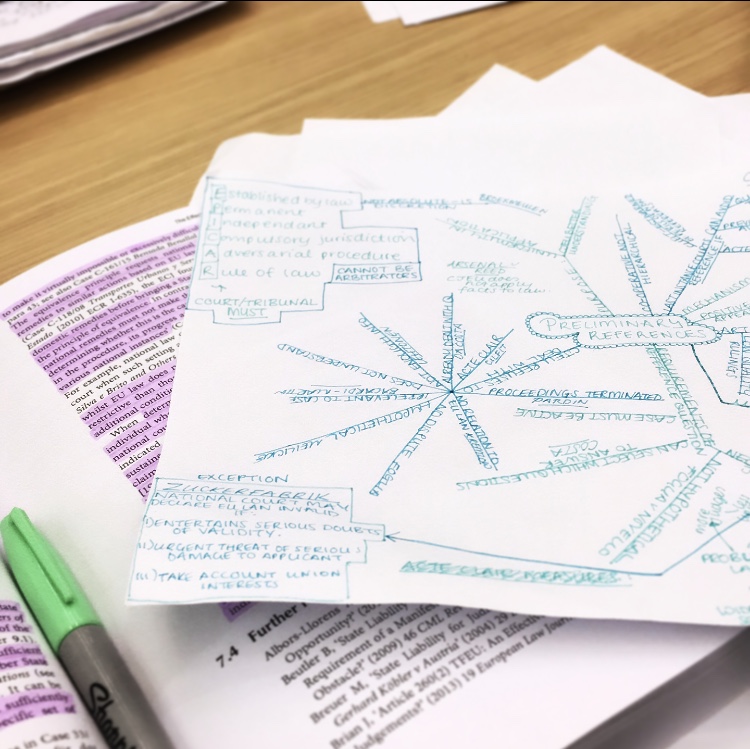
I LOVE mind maps. There was a presentation in school about the best ways to revise for the brain, and they showed us a particular way to create mind maps for the most effective revision. I’ve used this method ever since, and absolutely swear by it.
Tip 1: If you can, break an entire topic down into one mind map, and segregate the different aspects within it. You don’t want to have to look at multiple mind maps for one particular topic, you want it to be all tidy and in one place.
Tip 2: Use capital letters. According to a professional (don’t quite remember what he was qualified in) our brain processes capital letters easier than lower case ones.
Tip 3: Use different colours, I usually use a different colour on every line from the bubble I draw, however sometimes it is easier to have the different sections coloured accordingly.
I’ve uploaded a photo of one of my mind maps for you to get an idea of how I do mine, but of course it is up to you how you go about yours.
Necessity 3: Consolidation notes
Now this is something ideally, you’d do every week after your lectures, just consolidate all the necessary information into one document of notes, which you can then use for your revision to create mind maps and flash cards. Sometimes life does get too busy though, and so if you can’t do it every week that’s okay, just do what you can when you can.
Necessity 4: Study buddies
This is so incredibly helpful. Not only do you have someone to help you learn, test you and push you to keep going, you also have someone to panic and worry with. When I revise with Emma, we go through a topic, and usually after each page, or subject, we stop and talk about the things we have learnt, we write it down and test each other with our notes.
Once we’ve gone through an entire topic, we would create flash cards and mind maps, which we would use to test each other on at the end. Before this I would have revised primarily alone and then just used flash cards with friends before the exam, but now I’ve tried it this way, I wouldn’t go back to revising entirely solo.
The last tip I will give you in this post is to revise to schedule, because if you choose to revise only when you have the motivation to do so, you will barely revise. I hate to say it, but it’s true. Motivation is fleeting and unreliable, and you can go weeks without any at all, which is why you should create a realistic schedule of when you want to revise and try to stick to it. When I do this, I work in intervals, usually 20 minutes of revision and then a break, however this can be dangerous as the break will easily last longer if I open social media, or Netflix. Rewarding yourself for studying can be effective – a biscuit or ice-cream… this isn’t something that I do but have heard it works.
I bought a Clever Fox planner to schedule my time with, and what is really great about it is that you write in your goals, ranging from 3 months to 30 years, and it has a section for what you will reward yourself with if you achieve the goal. This could be used, if you set a goal to reach a certain grade, or revise a certain amount, then you’ll buy yourself whatever you’ve chosen. I’m pretty sure I set a target for what grade I wanted, and my reward (if achieved) will be a new laptop!
 The Law Student Diaries