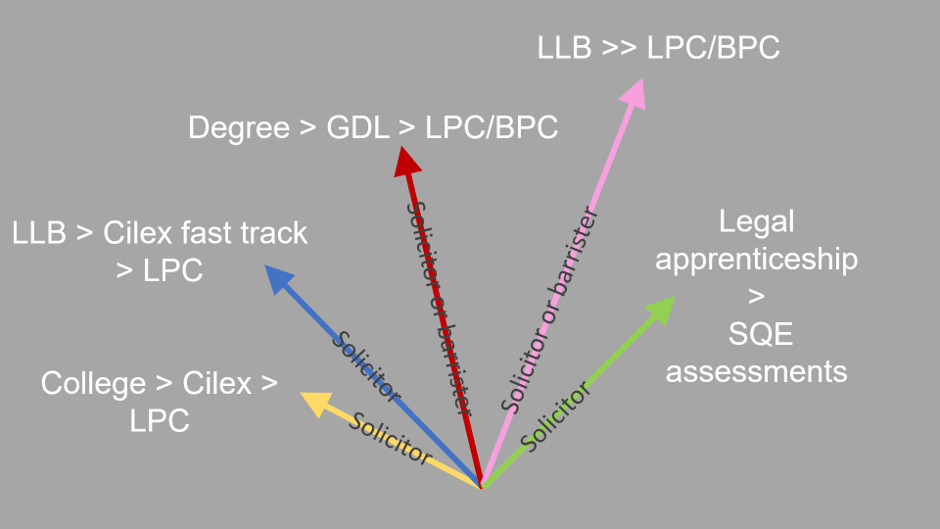
Now, the routes will always be subject to changes here and there, and as I write this now there is a huge shake up being planned for the route into becoming a solicitor, however I will cover what I can with what I currently know.
The route for a barrister and solicitor is comparable, but still very different.
Solicitor
The traditional route for a solicitor is:
- A qualifying Law Degree – when you choose your Y2 and Y3 module options there will be 2 in each that are necessary for a qualifying degree, if you don’t choose them you won’t be able to go onto the LPC after graduation.
- After you’ve completed your degree you will have to complete the Legal practice course, which if taken full time lasts one year (2 years for part time), this is where you learn the more practical and vocational skills, rather than theory.
- On completion of the LPC you will need to secure yourself a training contract. For most firms, training contracts are recruited for 2 years in advance, which means when you are in your second year you should be applying for training contracts. This is not to say that you won’t get one if you wait longer, you can apply for them at any time (once application windows open of course) but it just means you may have a year or two after your LPC until your training contract actually starts.
- ^^ If you’re in this boat, my advice to you is to try and gain as much legal experience as possible in the meantime, such as working for a firm as a paralegal.
The SQE (Solicitors Qualifying Exam)
The new approach to qualifying as a solicitor is being finalised at the moment, preparing for roll out in 2021, however considering how many times it has already been postponed, there is a good chance it will be further delayed. This new route has come about to make the path towards qualifying as a solicitor fairer and to standardise the content that is delivered to aspiring solicitors. The SQE consists of two assessments, the last of which is very practical, and so is likely to be difficult if you haven’t gained a great deal of experience.
The positive about this route is that training contracts are no longer required, instead you need to simply gain two years of experience working in a law firm in a capacity such as a paralegal or trainee role. It is also rumoured to be much cheaper than the current LPC’s that are on offer, which makes the route to becoming a solicitor also much more accessible.
Legal Apprenticeships
Solicitor apprenticeships are offered through law firms. Instead of going to university you earn a degree whilst working full time at the firm. This route to qualification lasts between 5 and 6 years and is taught entirely via online modules at the cost of the employer and the government. To qualify as a solicitor, you will need to pass the new SQE assessments instead of going onto an LPC.
Cilex
Both graduates and non-graduates can take this route, however the content and actually course taken will be different; graduates can take a fast track course to become a chartered legal executive, which is as you’d imagine, much quicker.
Now, becoming a chartered legal executive still requires you to complete an LPC to become a qualified solicitor, however, it exempts you from needing to fulfil a training contract to become a practicing solicitor. This is a huge bonus in a climate where training contracts are quite hard to get, but it does come at a small cost which you won’t get a loan for. Cilex are also teamed up with De Montfort university, and from what I gather, the LPC’s can be discounted in recognition of the graduate fast track qualification – but not for those who haven’t gotten a degree first.
Barrister
The traditional route to becoming a barrister:
- As I’ve said, this is pretty similar in terms of stepping-stones to becoming a solicitor. The first step is to complete a qualifying law degree at university (open uni or an institution but open uni is considerably longer).
- From this you will need to apply and complete the BPC (Bar practice course), which is the practical skills and knowledge of being a barrister.
- After your BPC you will have 5 years to attain a pupillage at a Chambers – this is no small feat, the pupillages are highly competitive, and the applications are an intensive and gruelling exercise. You are able to apply for pupillages a year in advance, however in my experience many BPC students don’t secure a pupillage until after the BPC, and it can take up to 5 years. If it takes longer unfortunately the BPC qualification will no longer be valid…
For the graduates without a law degree looking to become either:
The GDL
- If you’ve achieved a degree that isn’t in Law then you can still go on to the LPC or the BPC if you take a one-year course called the GDL (Graduate Diploma in Law), also known as the law conversion course. It’s more or less a crash course into the law to prepare you for the next stage of training.
- If you want to become a barrister, you will want to apply for the BPC after your GDL finished, whereas if you want to become a solicitor then you will want to apply for the LPC instead.
- On completion of those courses, barristers will need to find themselves a pupillage, and solicitors will need to secure a training contract. Again, you are able to apply for these two years in advance as well regardless of your degree discipline.
- ^^ This is actually a great route, and not a disadvantage at all, law firms are often looking for well-rounded candidates, and with life sciences and technology on the rise graduates from those disciplines are well sought after.
In summary, there are plenty of different options and paths to consider when becoming a solicitor, not so much for a barrister, and the best advice is really to research them all and choose the one that suits you best – even if it isn’t the path most followed.
 The Law Student Diaries